Artner’s basic approach to promoting sustainability activities is to support the growth and self-actualization of our engineers based on our management philosophy of being an “Engineer Support Company that supports our engineers’ dreams,” while seeking to maximize enterprise value, contribute to the resolution of social issues through our business activities, and build a foundation for sustainable growth and growth for the next generation. Based on this approach, we have established the following Basic Sustainability Policy as well as a human rights policy, procurement policy, and other policies to clarify the principles and direction of our corporate activities. In addition, considering stakeholder interests and social issues, as well as their impact on our business management, we have identified eight materiality topics (material issues) that should be prioritized and are engaging in effective management practices and business activities to resolve these issues.
To ensure that our sustainability initiatives are accessible to all stakeholders, we provide information in our Annual Report, on our sustainability website, and through other means.
| Cultivating people | To foster engineers to support manufacturing industries. |
|---|---|
| Employee happiness | To provide a workplace environment that makes the work of all employees meaningful and fulfilling. |
| Corporate governance | To sustain and develop positive relationships with all stakeholders, while strictly abiding by all applicable laws and regulations. |
| Contributing to society | To make a positive contribution to society through business, to help build a better and more prosperous world. |
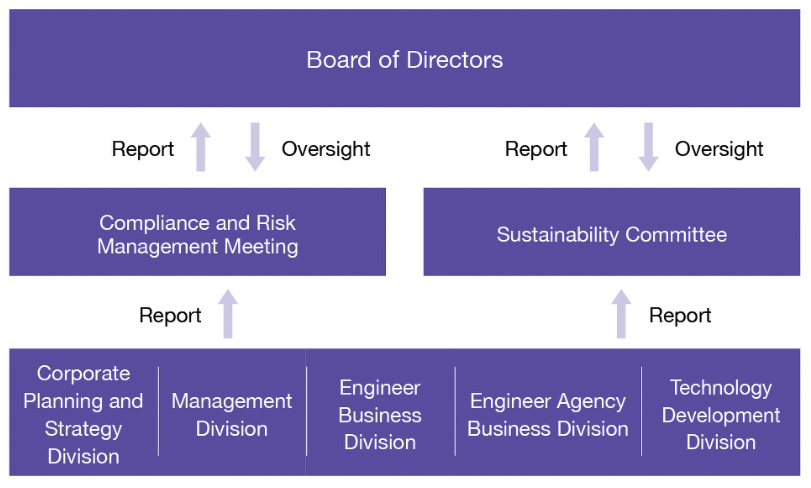
Artner sees sustainability issues, including social and environmental issues such as the recent SDGs and ESG, as key management issues, and has established the Sustainability Committee to serve as a structure to promote sustainability management. Under the direct supervision of the Board of Directors, the Committee is responsible for establishing sustainability policies, targets, and action plans, managing and evaluating progress toward these targets, deliberating on individual measures, and reporting to the Board of Directors.
The Committee, chaired by the President and CEO, is composed mainly of Directors who are not members of the Audit and Supervisory Committee, Directors who are members of the Audit and Supervisory Committee, and division heads and managers, and is held four times a year. Additionally, the Board of Directors deliberates on and resolves matters concerning sustainability-related risks and opportunities, including environmental and social risks, gives instructions on how to deal with them, and supervises the progress of such initiatives.
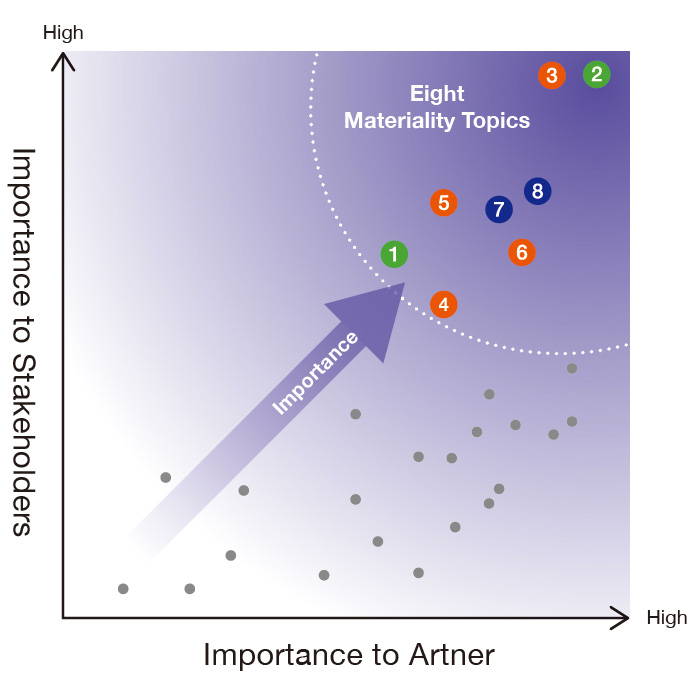
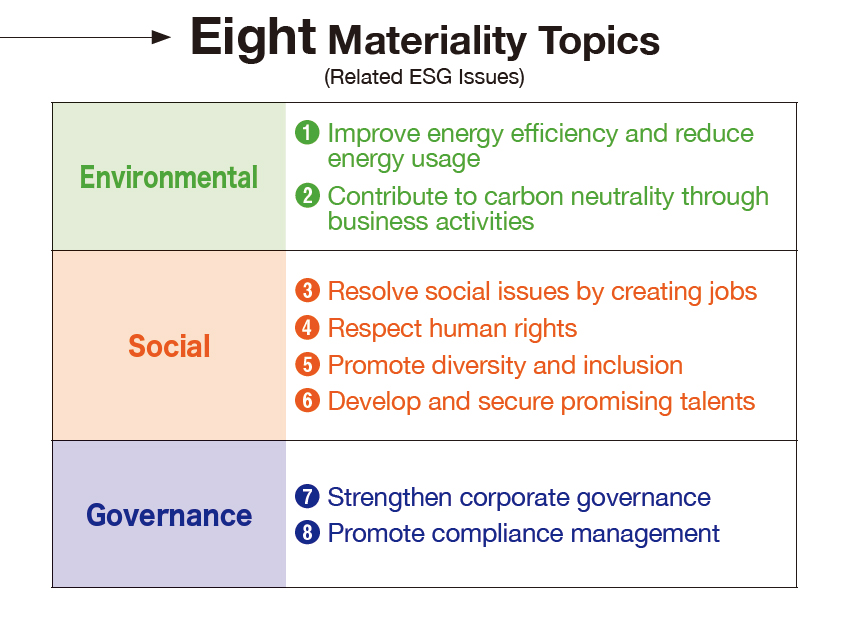
Considering stakeholder interests and social issues, as well as their impact on our business management, Artner has identified eight materiality topics that should be prioritized. Based on our understanding of the importance of the materiality topics we have identified, we are committed to engaging in effective management practices and business activities to resolve these issues.
 |
Identify the issues We analyzed potential materiality topics based on various international standards, ESG-related external evaluations, and requirements from society including stakeholders. Thirty-one topics were identified. |
 |
Prioritize the issues The identified issues were assessed by conducting internal and external stakeholder surveys in terms of their expectation and requirement levels for Artner, and then prioritized by two criteria: “importance to stakeholders” and “importance to Artner.” |
 |
Validate and determine the material issues Selected and prioritized issues were reviewed in the Sustainability Committee for validation to finalize Artner’s eight materiality topics. |
|
Identify the issues We analyzed potential materiality topics based on various international standards, ESG-related external evaluations, and requirements from society including stakeholders. Thirty-one topics were identified. |
|
Prioritize the issues The identified issues were assessed by conducting internal and external stakeholder surveys in terms of their expectation and requirement levels for Artner, and then prioritized by two criteria: “importance to stakeholders” and “importance to Artner.” |
 |
Validate and determine the material issues Selected and prioritized issues were reviewed in the Sustainability Committee for validation to finalize Artner’s eight materiality topics. |
In addition to clarifying the system for the overall management of various risks and opportunities, we classify and define each business risk and opportunity by type and have the department in charge of each type of risk and opportunity monitor and analyze the risk and opportunity situation. We also have a system in place for the overall management of various types of risks through the Compliance and Risk Management Meeting, where we clarify and implement the management and countermeasures for each type of risk. We manage sustainability-related risks and opportunities, including environmental and social risks, by theme. For climate change, we analyze the impact of environmental changes on our businesses and the effectiveness of response measures in accordance with the TCFD framework. We have also established a human rights due diligence system that administers questionnaire surveys to partners on their complicity in human rights violations and other topics.
We have categorized the eight materiality topics (material issues) into three areas (Environment, Social, and Governance), and set and monitor KPIs and targets for each issue. These indicators and targets are deliberated on and evaluated by the Sustainability Committee, then reported to the Board of Directors by the President and CEO, who chairs the Sustainability Committee. We review these materiality topics (material issues), indicators, and targets as necessary, based on the business environment and awareness of the issues.
*For materiality (material issues) KPIs, targets, and results, see “Non-financial Data (KPIs, Targets, and Results)” on pages 65 to 68.
Through its business activities, Artner aims to help resolve social problems, thereby contributing to the realization of the UN’s Sustainable Development Goals (SDGs) for the world.
| Category | ID | Item | Related SDGs | Reason for selection |
|---|---|---|---|---|
| Environmental | 1 | Improve energy efficiency and reduce energy usage |
 |
As a company, we have a social responsibility to reduce our offices’ electricity and resource usage, and energy-saving measures lead directly to cost reduction and environmental conservation. Reducing greenhouse gas emissions is also a societal demand. Our commitment to it will earn us stakeholders’ trust and fair appraisals of our enterprise value. |
| 2 | Contribute to carbon neutrality through business activities |
 |
The Medium-Term Business Plan (FY2026 to FY2030) sets out carbon neutrality as the pillar of our business activities. We will recruit and train engineers in the fields of electric vehicles (EVs), fuel cell vehicles (FCVs), semiconductor-related products, etc., and participate in more technology development projects, thereby seizing growth opportunities that will lead directly to enterprise value creation. | |
| Social | 3 | Resolve social issues by creating jobs |
 |
The core business of Artner as an Engineer Support Company is job creation through providing engineers with expertise in diverse fields. We are expected to help address the issues of labor shortages due to the declining birthrate and aging population and of regional revitalization. |
| 4 | Respect human rights |
 |
We have established our human rights policy based on the awareness that respecting human rights is a social responsibility we must fulfill as a company. It is essential for us as an engineer dispatching company to protect our employees’ human rights and working environments at clients’ sites. Since the occurrence of human rights violation can lead to the loss of trust, it is vital to ensure that we thoroughly implement measures against discrimination and harassment. | |
| 5 | Promote diversity and inclusion |
 |
Society expects that diverse talent, including women, people with disabilities, and non-Japanese, actively develop their careers. Such diversity and career development also help enhance the Company’s competitiveness. With government policies to promote women’s participation and advancement in the workplace, etc., promoting diversity will lead us to hire and retain human resources and create opportunities for innovation. | |
| 6 | Develop and secure promising talents |
  |
As the issues of the declining birthrate and aging population and of engineer shortages due to booming design and development activities in the manufacturing industry are becoming increasingly serious, talent development and retention are a source of competitive advantages. Providing well-developed in-house training and qualification acquisition assistance, creating more accommodating systems for employees’ skill development and ways of working, and benefiting society with our technological capabilities lead directly to our advantages in competition for excellent talent. | |
| Governance | 7 | Strengthen corporate governance |
−
|
As a company, we have a social responsibility to establish a fair and transparent corporate governance framework, which serves as the foundation for trust from external stakeholders. We will ensure greater transparency of the framework, faster processes, and enhanced internal control, thereby preventing scandals and establishing a stable management foundation. |
| 8 | Promote compliance management |
 |
Compliance with laws and regulations, coupled with robust information security, is the foundation of trust in a company. Given that any compliance violation can lead to the loss of social trust and to legal sanctions, it is essential to ensure compliance across the company. |
The Member States of the United Nations adopted the Sustainable Development Goals (SDGs) in September 2015. The aim of the SDGs is to achieve 17 goals by 2030 with a view towards ending all forms of poverty, fighting inequalities, and tackling climate change while ensuring that no one is left behind.

 Cookie Settings