 |
Identify the issues
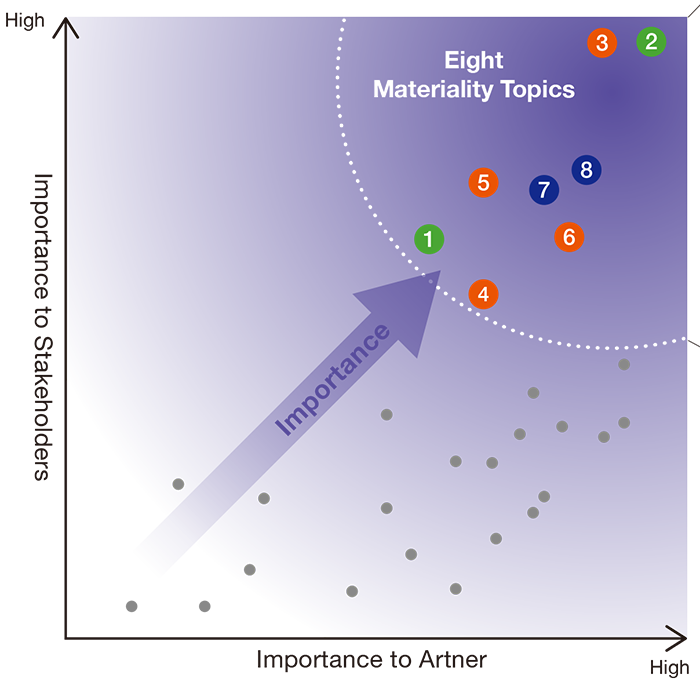
We analyzed potential materiality topics based on various international standards, ESG-related external evaluations, and requirements from society including stakeholders. Thirty-one topics were identified. |
 |
Prioritize the issues
The identified issues were assessed by conducting internal and external stakeholder surveys in terms of their expectation and requirement levels for Artner, and then prioritized by two criteria: “importance to stakeholders” and “importance to Artner.” |
 |
Validate and determine the material issues
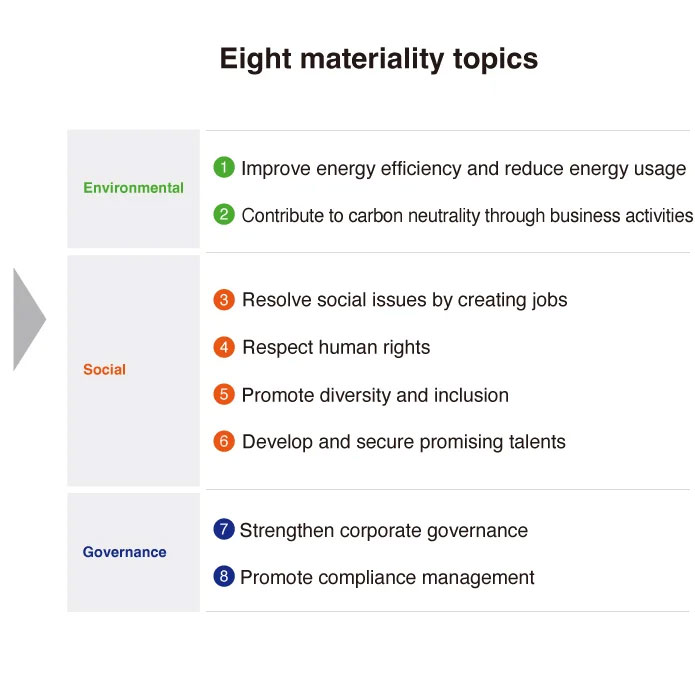
Selected and prioritized issues were reviewed in the Sustainability Committee for validation to finalize Artner’s eight materiality topics. |
|
Identify the issues We analyzed potential materiality topics based on various international standards, ESG-related external evaluations, and requirements from society including stakeholders. Thirty-one topics were identified. |
|
Validate and determine the material issues Selected and prioritized issues were reviewed in the Sustainability Committee for validation to finalize Artner’s eight materiality topics |
|
Prioritize the issues The identified issues were assessed by conducting internal and external stakeholder surveys in terms of their expectation and requirement levels for Artner, and then prioritized by two criteria: “importance to stakeholders” and “importance to Artner.” |

| Category | ID | Item | Related SDGs | Reason for Selection | Risk | Opportunity | KPI | Target | Initiatives |
|---|---|---|---|---|---|---|---|---|---|
| Environmental | 1 | Improve energy efficiency and reduce energy usage |
 |
As a company, we have a social responsibility to reduce our offices’ electricity and resource usage, and energy-saving measures lead directly to cost reduction and environmental conservation. Reducing greenhouse gas emissions is also a societal demand. Our commitment to it will earn us stakeholders’ trust and fair appraisals of our corporate value. |
・Declining reputation and technological obsolescence if we are slow to respond ・Increasing risk of extreme weather and natural disasters caused by climate change ・Increasing costs due to stricter environmental regulations, etc. |
・Increasing demand for dispatch of related engineers due to a growing need to adapt to a decarbonized and recycling society ・Increasing funding from ESG investors |
Greenhouse gas (GHG) emissions (Scope 1 and Scope 2) | Net zero (FY2051) | Promoting energy-saving efforts, such as saving electricity used for lights, air conditioning, and PCs in offices and switching to LEDs; regularly measuring electricity usage and CO₂ emissions and setting reduction targets; switching to low-carbon vehicles, such as renting EVs; exploring the possibility of adopting renewable energy; going paperless and reducing the usage of copy paper |
| Greenhouse gas (GHG) emissions (Scope 3) | Net zero (FY2051) | ||||||||
| Energy consumption (crude oil equivalent) | Reduction on an ongoing basis | ||||||||
| 2 | Contribute to carbon neutrality through business activities |
 |
The Medium-Term Business Plan (FY2026 to FY2030) sets out carbon neutrality as the pillar of our business activities. We will recruit and train engineers in the fields of electric vehicles (EVs), fuel cell vehicles (FCVs), semiconductor-related products, etc., and participate in more technology development projects, thereby seizing growth opportunities that will lead directly to corporate value creation. | Share of engineers placed in carbon neutrality projects among all engineers | 50.0% | Reinforcing the recruitment and training of engineers in the EV, FCV, and semiconductor-related fields; dispatching engineers to more carbon neutrality-related projects; building awareness through in-house training and information dissemination; supporting the TCFD recommendations and information disclosure based thereon | |||
| Social | 3 | Resolve social issues by creating jobs |
 |
The core business of Artner as an Engineer Support Company is job creation through providing engineers with expertise in diverse fields. We are expected to help address the issues of labor shortages due to the declining birthrate and aging population and of regional revitalization. |
・Increasing competition and costs in the talent acquisition market ・Declining quality of talent and labor productivity ・Declining reputation associated with human rights issues |
・More opportunities to acquire excellent talent ・Innovation creation through diversity ・Higher employee motivation ・Contributing to the realization of a sustainable society |
Share of carbon neutrality recruitment targets for new graduates and career hires | 55.0% | Reinforcing the recruitment of female/young engineers; supporting career pursuit through the job change assistance program |
| Turnover rate (engineers) *Excluding retirement and turnover via the Company’s assistance program to change jobs | Under 10.0% | ||||||||
| 4 | Respect human rights |
 |
We have established our human rights policy based on the awareness that respecting human rights is a social responsibility we must fulfill as a company. It is essential for us as an engineer dispatching company to protect our employees’ human rights and working environments at clients’ sites. Since the occurrence of human rights violation can lead to the loss of trust, it is vital to ensure that we thoroughly implement measures against discrimination and harassment. | Number of serious human rights issues | 0 | Human rights/harassment prevention training; establishing and operating a helpline to receive any reports on compliance violations and inquiries related to human rights and anti-corruption; surveys on the status of human rights initiatives intended for suppliers | |||
| Number of discrimination incidents | 0 | ||||||||
| Percentage of employees who have received harassment training | 100.00% | ||||||||
| 5 | Promote diversity and inclusion |
 |
Society expects that diverse talent, including women, people with disabilities, and non-Japanese, actively develop their careers. Such diversity and career development also help enhance the Company’s competitiveness. With government policies to promote women’s participation and advancement in the workplace, etc., promoting diversity will lead us to hire and retain human resources and create opportunities for innovation. | Share of female employees (engineers) | 10.0% or more | Establishing the Diversity Promotion Office; providing diversity training and LGBTQ+ workshops; increasing the number of female employees in managerial positions and improving the childcare and nursing care leave usage rates | |||
| Share of non-Japanese talents | Recruitment on an ongoing basis | ||||||||
| Employment rate of employees with disabilities | 2.30% or more (legally required employment rate) | ||||||||
| 6 | Develop and secure promising talents |
  |
As the issues of the declining birthrate and aging population and of engineer shortages due to booming design and development activities in the manufacturing industry are becoming increasingly serious, talent development and retention are a source of competitive advantages. Providing well-developed in-house training and qualification acquisition assistance, creating more accommodating systems for employees’ skill development and ways of working, and benefiting society with our technological capabilities lead directly to our advantages in competition for excellent talent. | Average hours of annual training per employee (engineer) | Same level each year | Skill Development Seminars, Career Support Courses, Manager training, and other education and training to support employees in upskilling; supporting career development through new employee training; qualification acquisition assistance; conducting online or in-person company information sessions and interviews; attentive regular follow-ups for universities and prospective employees; holding social gatherings and other events for prospective employees | |||
| Average cost of annual training per employee (engineer) | Same level each year | ||||||||
| Turnover rate (engineers) *Excluding retirement and turnover via the Company’s assistance program to change jobs | Under 10.0% | ||||||||
| Governance | 7 | Strengthen corporate governance |
−
|
As a company, we have a social responsibility to establish a fair and transparent corporate governance framework, which serves as the foundation for trust from external stakeholders. We will ensure greater transparency of the framework, faster processes, and enhanced internal control, thereby preventing scandals and establishing a stable management foundation. |
・Loss of social trust and deterioration of corporate value due to violation of laws and regulations or corporate behavior that deviates from social norms ・Increasing funding costs |
・Establishing a stable business foundation through more transparent decision-making and appropriate responses to changes ・Strengthening relationships with diverse stakeholders ・Increasing funding from ESG investors |
Appointment ratio of Independent Directors | One-third or more | Appointing Independent Directors and establishing relevant committees; holding Board of Directors meetings and committee meetings; establishing internal control and risk management frameworks; information disclosure (IR and the General Meeting of Shareholders) |
| Ratio of Outside Directors in the Nomination and Remuneration Committee | Majority | ||||||||
| 8 | Promote compliance management |
 |
Compliance with laws and regulations, coupled with robust information security, is the foundation of trust in a company. Given that any compliance violation can lead to the loss of social trust and to legal sanctions, it is essential to ensure compliance across the company. | Number of major compliance violations | 0 | Compliance and information security training; operating a whistleblowing helpline and an audit system; excluding antisocial forces and implementing anti-organized crime measures | |||
| Number of major information security incidents | 0 |
 Cookie Settings